Unlocking Urban Design Potential with an Isometric City Set of 3D Module
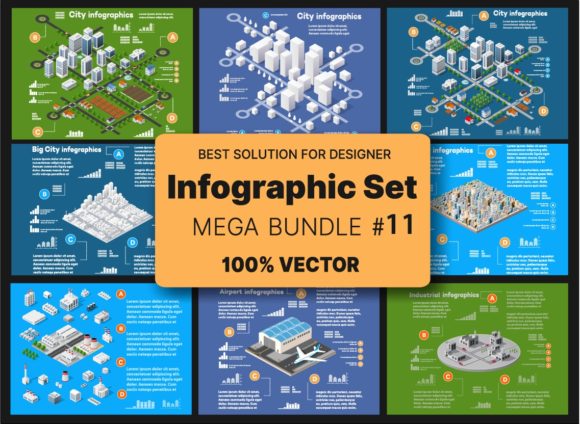
Visual storytelling has evolved rapidly in the digital age, moving away from flat, static images toward dynamic, depth-rich illustrations that capture the imagination. At the heart of this shift is the Isometric City Set of 3D Module, a versatile collection of vector assets designed to help creators build complex urban environments without needing advanced 3D modeling skills. Whether you are a game designer crafting the next indie hit, an architect presenting a conceptual neighborhood, or a DIY enthusiast planning a unique wedding invitation, these modular blocks offer a practical solution for bringing perspective cities to life.
The core appeal of an isometric set lies in its flexibility. Unlike traditional perspective drawings that vanish into a single point, isometric projections maintain parallel lines, allowing individual elements—like skyscrapers, street roads, and park areas—to fit together like a sophisticated puzzle. This block district approach means you aren't stuck with a pre-rendered image; instead, you receive a toolkit of scalable vector files, typically in formats like EPS, JPG, and AI, that can be rearranged, recolored, and resized to suit virtually any project.
Bridging the Gap Between Concept and Reality
For professionals in architecture and urban planning, the challenge often lies in communicating a vision to clients who struggle to interpret blueprints. An Isometric City Set of 3D Module serves as an excellent bridge here. By assembling pre-made modules of building construction areas, designers can quickly mock up a proposed development within its existing context. You can visualize how a new skyscraper interacts with surrounding infrastructure or how a green space integrates with street road construction. Because these files are editable, you can adjust colors to match specific material palettes or branding guidelines, offering a clear, bright illustration of the future urban environment before a single brick is laid.
Game developers, particularly those working on simulation or strategy games, find immense value in these assets. Creating a city from scratch requires thousands of hours of modeling and texturing. A high-quality vector architecture set accelerates this process significantly. Developers can pull specific elements—residential blocks, commercial zones, or industrial sectors—and layer them to create diverse maps. The fact that these are saved at high resolutions, such as 300 DPI, ensures that whether the game is played on a mobile screen or a large desktop monitor, the graphics remain crisp and professional. Furthermore, the ability to edit all colors allows studios to create distinct "biomes" or eras simply by shifting the hue of the base modules.
Elevating Personal Projects and Event Planning
Beyond professional industries, the utility of these digital clip art files extends deeply into the realm of personal creativity. Consider the modern trend of personalized event stationery. For a couple planning a city-themed wedding, standard store-bought invitations often feel generic. By utilizing an isometric set, they can design custom address labels, save-the-date postcards, and even cupcake toppers that feature a miniature version of the city where they met. The scalability of vector files means you can shrink a detailed skyscraper down for a sticker or blow it up for a large banner without losing quality.
Scrapbookers and paper goods enthusiasts also benefit greatly. Traditional scrapbooking relies on physical cutouts, which can be limiting. With a digital set of 3D modules, you can print exact sizes needed for your layout, mix and match elements to tell a specific story about a trip to a metropolis, or create unique party favors. Imagine creating custom clothing and accessories for a family reunion; printing a cohesive city skyline on t-shirts becomes a straightforward task when you have the right source files. The versatility allows these assets to move seamlessly from digital screens to physical products like calendars, signage, and gifts.
Navigating File Formats and Technical Considerations
When selecting an isometric set, understanding the file formats included is crucial for maximizing their potential. A comprehensive package usually includes .AI (Adobe Illustrator) and .EPS files alongside high-resolution .JPG images. The vector formats (AI and EPS) are the gold standard for designers because they allow for infinite scaling and color editing. If you plan to modify the structure of a building or change the color of a road, you need these editable vectors. The JPG files, often provided at 300 DPI, are perfect for immediate use in projects where editing isn't required, such as quick web graphics or direct printing.
However, there are practical considerations to keep in mind. While the modern bright illustration style is engaging, it may not suit every aesthetic. Projects requiring photorealism or gritty, dark tones might need significant modification of the base colors. Additionally, while the modular nature allows for endless combinations, users must pay attention to lighting consistency. Since isometric art simulates a light source (usually from the top-left or top-right), mixing modules from different sets with conflicting light directions can break the illusion of a cohesive 3D world. Always ensure the shadows and highlights align across the elements you choose to combine.
Diverse Applications Across Industries
The reach of an Isometric City Set of 3D Module spans far beyond just design and gaming. In the educational sector, teachers use these visuals to create engaging materials explaining urban geography, traffic flow, or community planning. The clear distinction between different zones—residential, commercial, industrial—helps students grasp complex spatial relationships. Marketing agencies leverage these assets for infographics, breaking down data about population density or real estate growth in a visually appealing way that retains viewer attention better than standard charts.
Even in the world of e-commerce, these modules find a home. Online stores selling urban-themed apparel or home decor can use these graphics to create lifestyle mockups. Instead of hiring a photographer to stage a product in a city setting, a designer can composite the product into an isometric scene, creating a stylized, branded look that stands out on social media feeds. The ability to edit every element means the background can be tailored to match seasonal campaigns, turning a summer cityscape into a winter wonderland with a few clicks.
Ultimately, the power of this tool lies in its ability to democratize high-quality design. You don't need to be a master illustrator to construct a compelling perspective city. With a robust set of vector elements, the barrier to entry lowers, allowing more people to experiment with urban infrastructure design, create professional-grade marketing materials, or simply add a touch of architectural flair to their personal hobbies. Whether you are building a virtual world or a physical invitation, the isometric module set provides the foundational blocks to let your creativity build upward.